

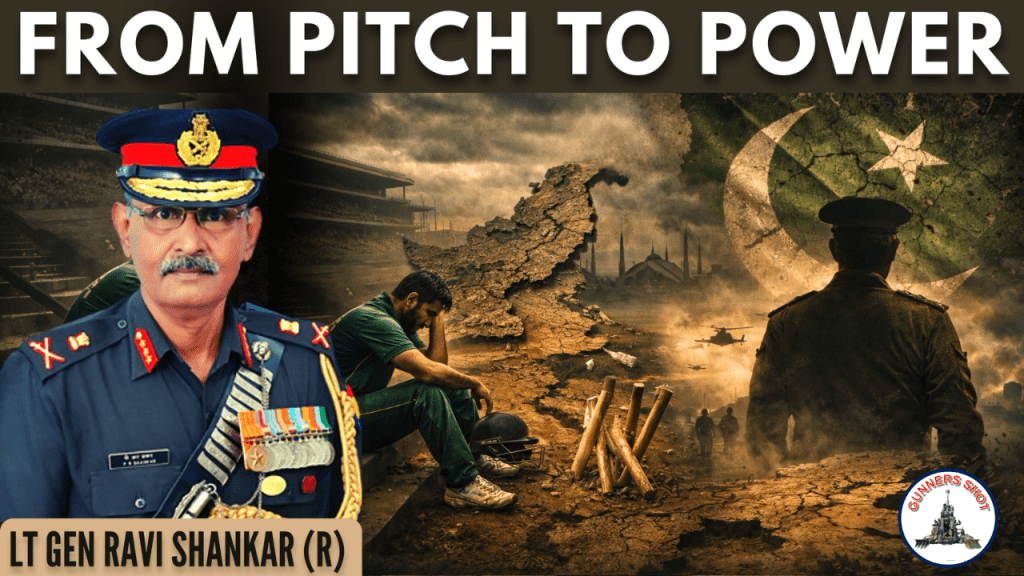
The historical rivalry between India and Pakistan has always transcended the boundaries of the playing field. In a recent discussion on the “GUNNERS SHOT”, Lt. Gen. Ravi Shankar (Retd.) and Mr Shree Iyer explored the deeper implications of Pakistan’s recent cricketing failures, arguing that the team’s performance is a direct reflection of a broader systemic collapse within the Pakistani state. The conversation highlights a nation that has regressed from a position of tactical brilliance and regional influence to one characterized by economic ruin, radicalization, and a delusional sense of “victory in defeat”.
The Inseparable Bond of Sport and Politics
A recurring theme is the fallacy of the “keep sports out of politics” argument. Historically, major sporting events have always been intertwined with geopolitics, such as the boycotts of the Moscow and Los Angeles Olympics or the 1936 Berlin Olympics. In the context of the Indian subcontinent, cricket and politics are particularly inseparable.
Pakistan’s cricket team has historically served as a barometer for the nation’s health. In the 1970s, 80s, and 90s, Pakistan was a strong, confident nation that produced world-class athletes in cricket and squash. The 1992 World Cup victory under Imran Khan was not merely a “flash of brilliance” but the result of a “team of brilliance” that reflected a functioning society. However, this strength has ebbed away over the last 25 years, and the current state of the cricket team—characterized by inconsistent individual efforts and frequent collapses—mirrors the nation’s overall decline.
The Crumbled “Pyramid” of Development
One of the most significant analytical points is the destruction of the developmental “pyramid” in Pakistan. A successful sporting nation requires a robust structure starting at the school level, moving through university and district ranks, and finally reaching the national level. Mr Shee Iyer and General Shankar note that this structure has “gone to the dogs” in Pakistan.
The reasons for this are not just administrative but ideological. The educational system has been compromised by radicalization, where “religion and radicalism” have been introduced into science and other curricula. When the foundational institutions—schools—are failing to provide a secular, skill-based environment, the resulting sports teams (and the broader workforce) lack the systemic resilience needed to compete internationally. Consequently, Pakistan is no longer producing teams with depth, relying instead on rare, individual bursts of talent that are insufficient for sustained success in a team sport.
A Nation in Systemic Collapse
General Shankar argues that Pakistan is currently experiencing a systemic collapse that touches every facet of the nation: its values, economy, education, and even its infrastructure, such as irrigation. He notes that while other neighbors, like Afghanistan, maintain a sense of pride and a desire to improve despite their poverty, Pakistan appears to be regressing uniquely.
The economic indicators are particularly dire. The nation is reportedly heading toward 50% poverty, with frequent power and fuel shortages. Despite being a nuclear-armed state, Pakistan has failed to translate that power into national progress. This regression is also seen in their international relations. In the past, Pakistan was strategically savvy, playing major powers like the US and China against India. Today, those relationships are strained or purely transactional.
The Delusion of “Victory in Defeat”
Perhaps the most psychological aspect of the discussion is the Pakistani mindset regarding its rivalry with India. The speakers describe a phenomenon where Pakistan seeks “victory in defeat.” For the Pakistani establishment, victory is defined not by winning, but by the “ability to continue fighting”. This allows the state and its media to spin every loss—whether in war or on the cricket pitch—as a form of success because they are still standing and “at par” with India.
This mindset is described as massochistic and regressive. There is a perceived desire within the Pakistani psyche to pull India down to its level rather than focusing on its own growth. General Shankar cites examples of Pakistani media spinning a defeat as a victory “before the first ball has been bowled” and making wild claims about military engagements to maintain a facade of parity. This “eternal victimhood” and refusal to take ownership of their failures prevents the nation from correcting its course.
Pakistan as the “Garbage at the Doorstep”
The most controversial and hard-hitting metaphor used by General Shankar is that of “garbage” intentionally placed at India’s doorstep. He argues that while many Indians want to look beyond Pakistan and focus on China or the US, Pakistan remains India’s primary military and diplomatic focus because it is a constant source of instability.
He posits that external powers, specifically the USA and China, use Pakistan as a tool to “poke” India and disrupt its progress. He highlights a duality in US policy, where the Indo-Pacific Command engages positively with India while the Central Command (based in the Middle East) continues to maintain deep ties with the Pakistani military establishment. This duality ensures that Pakistan continues to thrive, supported by foreign aid and military recognition.
The Path Forward: Sanitization and Vigilance
General Shankar is blunt about the solution to this enduring problem. He suggests that the “garbage” must be sanitized. Because Pakistan in its current form will always be a problem for India, he suggests that the only long-term solution is to “break” the current construct of Pakistan, whether through political, economic, or water-related strategies, rather than direct military conflict.
He emphasizes that India must break Pakistan’s “nuclear thinking” through political means. The goal is to move past the era where Pakistan can use its nuclear status to shield its state-sponsored provocations. Until then, India must remain “on the guard,” recognizing that the threat is persistent, even if it appears as a “mosquito” that only occasionally causes “malaria”.
The Disengagement of the Diaspora
The discussion also touches upon the role of Non-Resident Pakistanis (NRPs). Mr Shree Iyer observes that unlike the Indian diaspora, which actively engages in improving their homeland, well-educated and affluent Pakistanis who move abroad often seem to want nothing to do with Pakistan. Their relationship with their home country is described as “transactional,” often centered around property or seeking a “cut” of international aid like IMF disbursements. This lack of intellectual and financial “infusion” from its successful citizens further stunts Pakistan’s ability to rise from its current state.
Conclusion: A Warning to the Future
The video concludes with a somber look at the future of the region. The speakers warn that the “two-faced” nature of the Pakistani establishment and its ability to articulate its “victimhood” in the West (particularly in the UK and US) creates a “bigger mess” that could lead to future global instability, similar to another 9/11.
For India, the takeaway is clear: while the nation is on an upward trajectory with advancements in AI and global diplomacy, it cannot afford to ignore the decaying state on its border. The systemic collapse of Pakistan is not just a Pakistani problem; it is a regional hazard that requires constant vigilance, strategic sanitization, and a clear-eyed understanding of the enemy’s mindset. The cricket match, where they “came, saw, and collapsed,” is simply the most visible symptom of a much deeper, national terminal illness.


Leave a Reply