

By
Lt Gen PR Shankar, PVSM, AVSM, VSM (R)
Published in Strategic Reflections, 2024 by CENTRE FOR LAND WARFARE STUDIES (CLAWS), OCT 2024, SABRE & QUILL PUBLISHERS, NEW DELHI. Pages 203- 221
General
Transformation of the PLA began with ‘four modernisations’ under Deng Xiaoping. Since then, China has been consistently enhancing its defence expenditure in order to build a modern world class armed force. As China’s economic and global influence has grown exponentially, Xi Jinping embarked on high profile mission of building the strongest military on earth on tight time lines[1]. He is sparing no effort and is spending a huge part of China’s GDP to equip PLA with modern weapons based on cutting edge technologies. It is constantly reported that PLA is on a fast track to achieve its centennial goals by 2027[2]. All this is being done under international limelight accompanied by huge propaganda. Hence there are numerous articles like ‘China’s Pursuit of Unorthodox Force Multipliers (Including Cyberspace)’, ‘Artificial Intelligence in the PLA’, ‘Contest for Control of Low Earth Orbit’, ‘China’s Directed Energy Weapons and Counterspace Applications’, ’New Mechanisms to Accelerate Military Innovation’, ‘Deployment of Drone Swarms in Conflict’ and so on and so forth. Xi Jinping’s vision for PLA to use AI to achieve “intelligentization” to build a “world-class” military makes ominous news. The endeavour is to make PLA into a hi-tech force which is fully enabled to fight and win future wars.
In accordance with this thrust on technology and modernisation, PLA has been provided with requisite political and military guidance by the Chinese Communist Party. The Party line about warfare and national defence issues is based on the thoughts of Karl Marx, Mao Zedong, Deng Xiaoping, Jiang Zemin, Hu Jintao, and now Xi Jinping[3]. Xi Jinping’s ambitious reform and reorganization of the PLA includes the theatre command system, establishment of an additional forces ie the PLARF equivalent to the Army, Navy and Air Force and establishment of independent arms like the Information support Force, The Aerospace support force and the Cyberforce support force. Xi is also focused to try and make China a great maritime nation [4].
The combination of hi tech modernisation, reformed organisations and clear cut political direction makes the PLA a fearsome war machine. The impression one gains is that this shiny instrument of force will be unstoppable in battle. However, there are issues which force a pause to rethink. The first major issue which keeps cropping up is that the venerable PLA is inexperienced and Xi Jinping is worried that his soldiers might not be able to win battles[5]. The second issue is that recent wars in Ukraine and Gaza indicate that while it is extremely important to have hi-tech networks, cyber systems based on space technology and driven by AI; battles have to be fought on ground with good old brick and mortar weapons – guns, tanks and rockets et al. In this regard, the PLA remains saddled with many legacy systems[6] . It must be understood that it is impossible for any armed force to fully modernise itself with latest weapon systems in the short time period since the commencement of modernisation. The PLA is no different. Further, while there is lot of talk of high technology infusion, it needs to be examined if the mainstay weapon systems are really that modern to give the PLA a winning edge. It is in this connection that an examination is being made of three of PLA’s weapon systems- Tanks, Guns and Rockets. This will give us and idea if the PLA really has an edge over its rivals.
Tanks
China’s tanks were basically of Soviet origin. They were relatively outdated compared to the advanced foreign designs of the West and USSR/ Russia. However rapid growth of the Chinese economy and expansion of its defence industrial base has enabled development of capable tanks. Presently China has three separate tank designs in production for its own armed forces, and a further two in production exclusively for export.
The PLA is estimated to have about 8000 tanks including those in reserve[7]. Many of them are obsolete and held by their second line units. Their main front line units with armoured divisions are equipped with about 2000 Type 96 MBTs. A few elite units are equipped with the latest Type 99 MBT , of which there are about only 300 in service. The other tank which merits examination is the ZTQ-15 which is a light tank mostly deployed in high altitudes. The Type 99 and the ZTQ-15 therefore need examination to see how modern or technologically advanced they are.
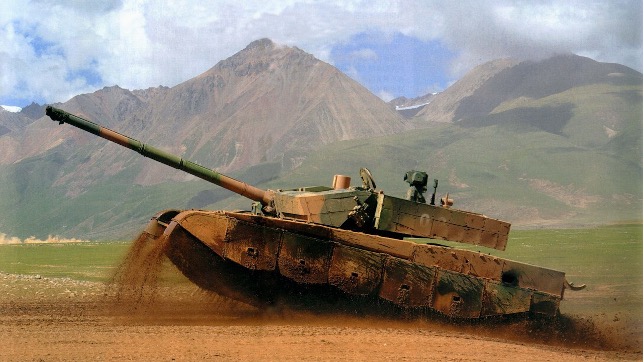
Type 99A2/ZTZ-99A2. The Type 99 A2 is also known as the ZTZ-99A2 MBT. Its development began around 2003. It was introduced into active service in 2011. It has a 1500 hp powerplant, a 125 mm smoothbore gun capable of firing an ATGM. The gun can fire a variety of ammunition including APFSDS rounds. It also has a 12.7mm anti-aircraft machine gun and a 7.62mm co-axial machine gun. The basic technology is an improvement over the earlier Type 96 MBT. The wheel train, suspensions and tracks are the same as the Type 96 MBT to achieve standardisation. It is designed to be shorter with a more compact chassis. The tank has composite armour and modular armour for enhanced protection against kinetic energy penetrators and high-explosive anti-tank (HEAT) projectiles. It also has semi passive ERA protection and is fitted with a new active protection system. There have been improvements in communications, networking and battlefield awareness. The tank is equipped with a modern fire control system, including thermal imaging and laser rangefinders. It enables effective target acquisition and accurate firing on the move. The 1500 HP liquid-cooled, turbocharged diesel engine is powerful enough to compensate the increased weight of armour. The ZTZ-99A2 is said to have a top speed of 75 kph. The tank has a crew of three – driver, gunner, and commander. So far about 500 tanks have been produced. The Type 99 is considered one of the most capable main battle tanks in the PLA and seems to be the mainstay of China’s efforts to modernize its armoured forces[8].
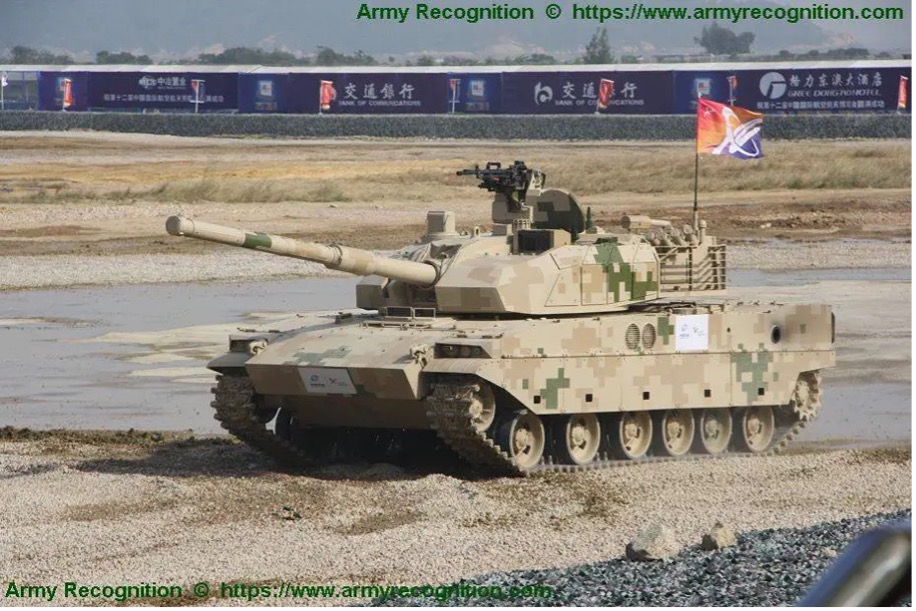
ZTQ-15. The ZTQ-15 is a light tank with a ‘long barrel’ 105 mm rifled barrel which was introduced into service in 2015. It has three versions, a fully armored type,[9] a marine type, and an export type called VT5. It has also been called the “mountain tank” and has been deployed in southern China in hilly and mountainous terrain. The mountain version has an engine tailored to suit the low oxygen high altitude conditions. The tank weighs around 33-36 tons and has a hydro-pneumatic suspension to operate in rough the terrain. It is said to be designed to be able to defeat any APFSDS round from a T-55 or T-72 tank. That is questionable. It is reputed to be easy to transport. The tank has systems which provides with good battlefield awareness, strong information capabilities, and high manoeuvrability. It is well suited for export. The VT-4 has been exported to Thailand, Nigeria and Pakistan. Bangladesh is also interested in acquiring this tank. It shares subsystems and technologies with the Type 99. The tank provides China with an advantage over India which currently lacks a similar mountain tank. However that might soon change with the induction of Zorawar.
Guns
PLA holds about 8900 pieces of artillery. This includes about 2800 mortars of various varieties. Many of these are legacy pieces. The majority of guns in the PLA are of 122mm calibre. There is major modernisation drive underway. The first trend in the PLA is mechanisation through Self Propelled guns and MBRLS[10]. As part of this trend, the PLA is replacing towed guns with Self Propelled guns or Mounted Gun Systems. The second trend is that it inducting more 155 mm guns. In this connection it will be pertinent to examine some of their frontline 155 gun systems which are likely to appear opposite the LAC in future conflicts.
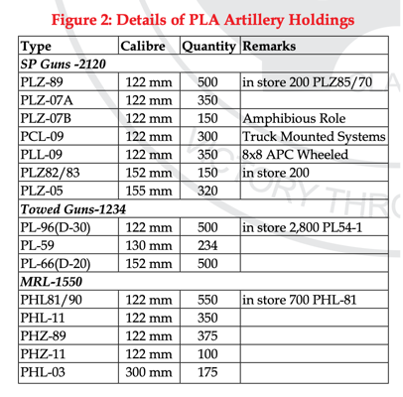
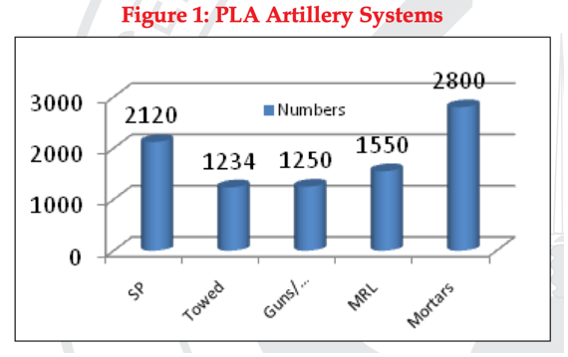
Source : CLAWS Issue Brief 220 ( https://www.claws.in/static/IB-220_Appraisal-of-PLA-Artillery-Modernisation.pdf )
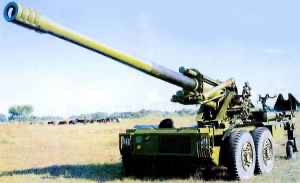
PLL01/ W88/890. This is a gun-howitzer of 1987 vintage. It was the first PLA artillery system which adopted the NATO-standard 155mm calibre. The gun is based on the Austrian GHN-45 technology. Later, the PLA developed its own version of the 155mm/45-calibre howitzer known as W88. This was designated as PLL01. This basic gun design was used to develop the PLZ45 self-propelled gun-howitzer system. This is a 45 calibre gun with a range of 24km with normal ammunition, 30km with the extended-range full-bore (ERFB) rounds and approximately 39km with the extended-range full-bore base bleed (ERFB-BB) rounds. It has a max MV of 903m/s. It has an intense rate of fire up to 4 rounds per minute and normal rate of fire of 2 rounds per minute. Most of its systems are hydraulically operated. The basic power is derived from a 77 hp APU that can achieve speeds up to 18km/h with a range of 80km. The carriage has four large wheels. It has a swing around barrel which reduces the length of the howitzer from 13m to 9m when towed. The PLL01 has a combat weight of 12 tons (with APU) and 9.8 tons (without APU). The howitzer is towed by an 6X6 truck at a maximum speed of 90km/h. A light weight variant has also been inducted which is fitted on the two-wheel carriage of the Chinese 130mm field gun. However, this variant is less stable when firing[11]. This is similar to our Soltamisation. The ATAGS when inducted will be a magnified and modernised version of this gun.
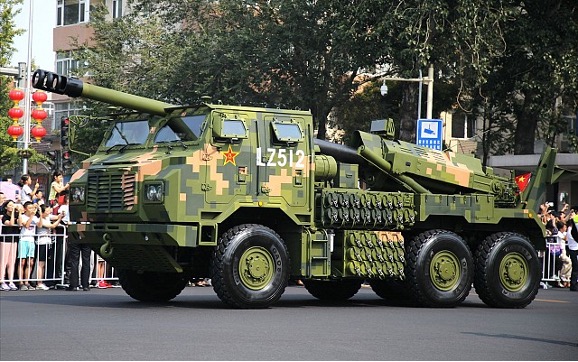
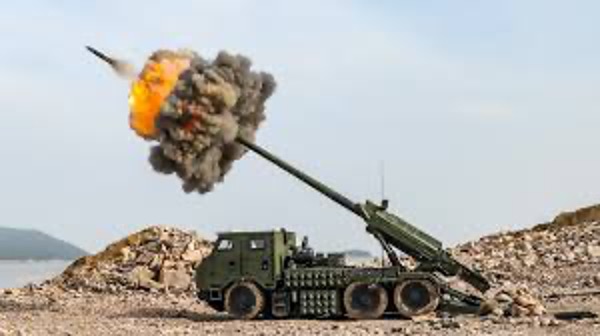
PCL181/ SH-15. The PCL 181 is a modern Chinese self-propelled howitzer. Essentially it is a Mounted Gun System based on a Shaanxi 6×6 truck chassis with an armoured cab. In the firing position, two large hydraulic jacks are lowered. Shells and charges are stored on the sides of the truck. The PCL181 is 155mm 52-caliber howitzer that can fire the Chinese range of NATO standard shells. It has a semi-automatic loading mechanism which enables a rate of fire of 4 to 6 rounds per minute (questionable). With rocket assisted ammunition a range of 53 km can be achieved. The major advantage being touted is that it is much faster into and out of action compared to towed howitzers (specially the M777 ULH). This aspect will be discussed later. It also has a shoot and scoot capability to evade counter battery fire. It has a maximum weight of 25 tons. Two guns can be loaded onto an Y-20 transport aircraft. It is designed to be transported by rail anywhere in China. The PCL-181 is equipped with an automatic aiming and fire control system (AFCS). 100 pieces of the PCL181 have been inducted by the PLA in Tibet. The PCL181 was first shown in the 2019 parade and was used during exercises in 2020. Prototypes were tested and shown for export in 2017 and 2018. Pakistan has ordered over 200 SH-15s, the export version of the PCL181. [12]
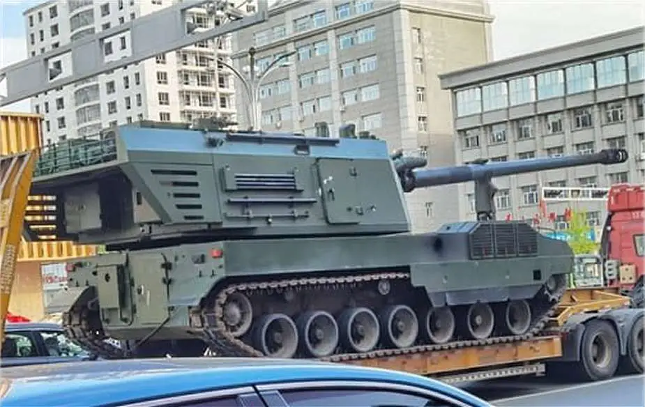
SH16 . China has recently unveiled the 155mm SH16 which is a cutting-edge 155mm tracked self-propelled howitzer equipped with a fully autonomous artillery turret[13]. The SH16 requires just two crew members for operation: a driver and a gunner/commander. It has a fully autonomous unmanned turret with an automatic loading system. The basic system is the PCL-181 MGS with a 155mm 52 calibre barrel. As per reports China has incorporated an innovative automated rotary magazine for modular charges. This system, includes at least seven magazine tubes, with each capable of holding up to six propellant charges. This magazine significantly enhances the rate of fire and operational flexibility as per reports. The SH16 is a comprehensive system with a modular approach which is supposed to enhance the system’s combat capabilities and is a show piece of China’s pioneering effort in military technology. The modular turret’s weight is under 14 tons, and the total combat weight, including the truck chassis, is capped at 32 tons. This makes the SH16 highly manoeuvrable on the battlefield. The standardization of armament is in line with the PCL-181and simplifies logistics and ammunition supply chains. The automation and advanced control systems embedded in these platforms enable precision targeting and firing, crucial for achieving tactical objectives with minimal collateral damage.
203mm Gun. The PLA’ has recently announced that it is look at inducting a 203mm gun system. Its specs include firing of an 85kg projectile at about 920 m/s[14]. This future artillery system may be intended to destroy strategic underground or reinforced targets which are a prominent feature of Taiwan’s defences. Interestingly, the development is being spearheaded not by the PLA or PLARF but by the erstwhile PLA Strategic Support Force. Chinese sources speculate that this more powerful artillery could bridge the gap between the PLA’s smaller-calibre, shorter-range artillery and its longer-range rocket artillery[15]. This is a system under development. It must be understood that large calibre artillery systems have drawbacks; which led to abandoning calibres larger than 155mm them decades ago. These drawbacks include : a lower rate of fire; bulky, hard-to-move firing platforms; and difficult logistics. Despite this the Chinese appear to be going in for this system. This research effort needs monitoring.
Tactical Rockets
The international focus is on the China’s PLARF which is essentially a strategic force with a bevy of ballistic, cruise and hypersonic missile systems with conventional and nuclear warheads. These systems might not feature in local wars / small skirmishes. The PLA will in all probability will use tactical rockets for small scale conflicts / limited wars. These multiple rocket launcher systems have calibres varying from 122mm to 370mm. The PLA will use these systems in tactical operations to support ground forces as also to offset its deficiency of air power in High Altitudes of Tibet. Hence an examination of these systems and their technology is also pertinent.
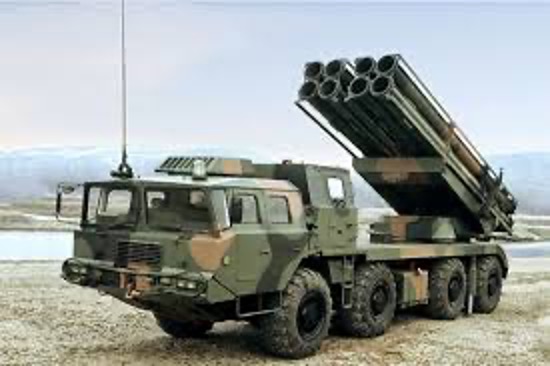
AR-3 /PHL-16 Multiple Rocket Launcher System. The AR3 is a modular multiple rocket system which can fire 300mm and 370mm rockets and 750mm tactical ballistic missiles [16]. It is similar to the Smerch sytem, but is vastly upgraded. The 750mm ballistic missiles are primarily for Taiwan contingencies however its use in Tibet cannot be ruled out. The PHL-16 nomenclature is for its export models. The AR3 MLRS can fire as part of a battalion, battery or as a single firing unit in an autonomous mode. It has an advanced meteorological, survey, command & control and support system. It has two launch modules. Each module can fire five 300mm rockets, four 370mm rockets or one 750mm rocket. Each module can be mounted with different type of rocket to achieve better flexibility. The rocket launcher is based on 8×8 high-mobility carrier chassis and can achieve a speed of 60 kmph. It can be handled with a crew of three. The 300 mm rocket has an effective range of 150 km. The 370 mm rocket has a range of 280 km. The 750 mm rocket has a range of up to 300 km. The rockets use satellite based precision guidance and is reported to have an accuracy of 10 m[17]. The modular approach to rockets has its advantages. However it also has serious disadvantages and is not a battle winning factor.
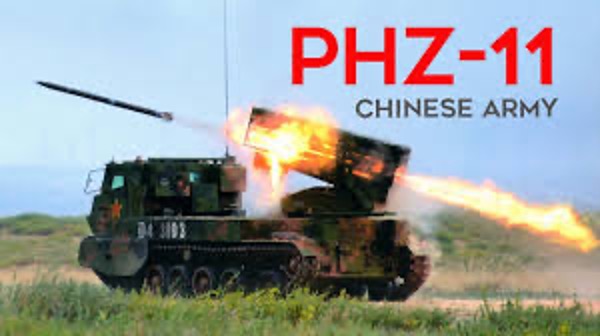
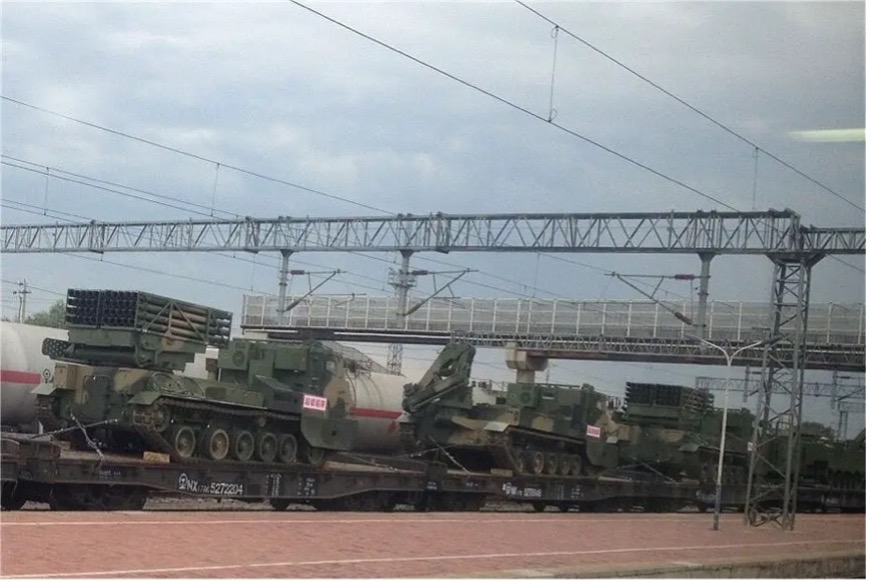
PHZ-11 122mm Multiple Launch Rocket System. In 2020 the PLA show cased the PHZ-11 122mm Multiple Launch Rocket System (MLRS) on tracked chassis. It is reportedly now in service with its Heavy Combined-Arms Brigade of the 76 Group Army in Western Theatre Command[18]. It is on the same tracked chassis as the PLA’s 155mm self-propelled howitzer. It is operated by a crew of three which includes a driver, gunner and commander. It is fitted with two pods of 20 launchers that are arranged in four rows of five tubes. It can be fired from the crew cabin. The vehicle might be fitted with a land navigation system (LNS) and a computerized Fire-Control System (FCS) which allows for autonomous operation. It can fire different types of unguided solid propellant 122 mm rockets including mine laying, fuel-air explosive, HE High Explosive, steel ball HE, and steel ball HE incendiary with a range from 15 km to 30 km[19]. In simple terms it is a GRAD BM 21 on tracks.
Analysis
The weapon systems described above are the latest in the PLA inventory. Some of them are yet to be introduced into service. From available data most of these are introduced into service in small numbers. The bulk of the PLA appears to remain a force with older and legacy systems. Hence in actual battle the PLA will not have a decisive technological advantage. This needs confirmation through focussed research.
When the cutting edge weapons are analysed in detail, it comes out clearly that the Chinese weapons do not have any technological feature which gives them an overwhelming edge. Most features in these systems are standard features which are available with equivalent systems anywhere else including in the Indian Army. The major advantage which the PLA has is that it is backed by a deep rooted industrial complex fully driven by civil military fusion. This is force multiplied by a political system which has deep pockets for defence modernisation. This enables rapid design , development, production and deployment.
The weapon systems analysed above are made for the PLA based on their operational necessity, their terrain features and their operational doctrine/concepts. Many features incorporated in their weapons are incongruent to our / others requirements. Many features showcased are misleading. While a SP gun can be handled by a crew of 2-3, the real issue is handling of ammunition. Irrespective of how well the weapon is automated, it is the logistics of the weapon which will ultimately dictate its efficacy in battle. On that issue not much information is available.
Some of the comparisons drawn by Chinese to prove that their guns are better than ours is utter nonsense. For example, a 25 ton MGS can not be compared with a 4 ton M777 ULH. Their roles and employment in battle will be completely different. To put it on record, the M777 ULH, to my mind is the only modern light gun with cutting edge technology with incomparable tactical and strategic mobility. Hence following the Chinese cues in design and technology without seeing things in context is fraught with danger. One must remember that many of the Chinese designs are neither battle tested nor are they born out of operational experience.
The PLA is the world’s largest armed force. However its soldiers have virtually no combat experience[20]. This is probably reflected in their design and production of their weapon systems. It has been assessed that Chinese weapons cannot compete with those made in Russia, Israel, France, or the US[21]. Many of their frontline weapon systems are unreliable, malfunction and break down frequently. Complaints of low/poor quality also surface periodically. Cases of high profile corruption have come to fore in the PLA in which their former defence ministers have been sacked[22]. Their corruption is apparently related to rocket and missile systems of the PLARF. However if there is corruption in PLARF procurement leading to sub-standard equipment can it be far behind in PLA?
It is now well established that China’s defence industry has exported malfunctioning and defective military equipment in recent years. Major countries to which China has exported substandard equipment include Nigeria, Myanmar, Bangladesh and Pakistan[23]. There are other countries in Africa, Latin America and Asia which have had similar experiences. These equipment are beyond guns, tanks and rockets alone. The malfunctioning equipment extends to aircraft, ships and submarines. It can be argued that the equipment China sells to other countries is value engineered and hence could be prone to failure. However a large part of the failure can be attributed to poor design and technology if the whole issue is properly investigated.
Conclusion
When the brick and mortar weapons systems are analysed in detail, it emerges that while some part of PLA is modern, a substantial part of it is still based on legacy systems. Even the modern systems are technologically not superior to other equivalent systems in other armies. Further the efficacy of these weapons depends totally on how well they have been integrated into a recce strike system based on surveillance, networking, navigation and communication. Going a step ahead it is also a point to ponder that if the legacy systems have been upgraded to be compatible with new weapon systems and have been integrated with their recce strike system.
All in all it is recommended that a multidisciplinary study be undertaken to actually flesh out the reality of the technological competence of the PLA , which to my mind is suspect.
[1] https://www.armyupress.army.mil/Journals/Military-Review/English-Edition-Archives/January-February-2024/Sullivan/
[2] https://www.globaltimes.cn/content/1208192.shtml
[3] https://gunnersshot.com/2023/12/19/plas-military-strategy-and-guidance-a-historical-perspective-by-lt-gen-p-r-shankar-r/
[4] https://warontherocks.com/2024/06/chinas-new-info-warriors-the-information-support-force-emerges/#:~:text=The%20new%20force%20will%20be,accuracy%20of%20Chinese%20decision%2Dmaking.
[5] https://www.economist.com/special-report/2023/11/06/xi-jinping-worries-that-chinas-troops-are-not-ready-to-fight#
[6] https://www.iiss.org/en/online-analysis/military-balance/2019/08/china-army-modernisation/
[7] https://tank-afv.com/modern/China/Chinese-Tanks.php
[8] https://tank-afv.com/modern/China/Chinese-Tanks.php
[9] https://www.armyrecognition.com/military-products/army/main-battle-tanks/light-tanks/vt5-light-weight-main-battle-tank-technical-data-sheet-specifications-pictures-video-11711164
[10] https://www.claws.in/static/IB-220_Appraisal-of-PLA-Artillery-Modernisation.pdf
[11] http://www.army-guide.com/eng/product4175.html
[12] http://eng.chinamil.com.cn/CHINA_209163/TopStories_209189/9808544.html
[13] https://armyrecognition.com/news/army-news/2024/china-unveils-sh16-155mm-first-tracked-howitzer-with-fully-autonomous-artillery-gun-system
[14] https://www.defenseone.com/threats/2023/04/chinas-secretive-quest-heavier-artillery/385709/
[15] https://k.sina.com.cn/article_2019914355_78657273020017y2n.html#/
[16] https://www.defense-aerospace.com/chinese-army-debuts-new-tactical-ballistic-missile-media/
[17] https://www.globalsecurity.org/military/world/china/ar-3.htm
[18] China’s Army Has a New Multiple Launch Rocket System. Here’s What We Know. | The National Interesthttps://nationalinterest.org/blog/buzz/chinas-army-has-new-multiple-launch-rocket-system-heres-what-we-know-149181
[19] https://www.armyrecognition.com/news/army-news/2020/new-chinese-army-phz-11-122mm-mlrs-multiple-launch-rocket-system-on-tracked-chassis
[20] https://www.rand.org/pubs/commentary/2018/11/chinas-military-has-no-combat-experience-does-it-matter.html
[21] https://www.defencexp.com/chinas-pla-numbers-in-the-front-darkness-behind/
[22] https://www.scmp.com/news/china/military/article/3268303/former-chinese-defence-minister-li-shangfu-under-investigation-corruption
[23] https://www.rand.org/pubs/commentary/2023/06/countries-buy-defective-chinese-military-equipment.html

 Gunners Shot
Leave a comment