

Published By CENJOWS in Synergy
Feb 2024 Issue Pages 1-13
Space : The Fourth Dimension of War
Traditionally wars were fought in three dimensions – land air and sea. As early as the 80’s, it was felt that Space was the fourth and newest military dimension[1]. Military experts began discussing space power, its implications and impact of new technologies on battle. Space was extensively utilised by USA during the first Gulf War in 1990-91. It provided precision capabilities to the coalition forces. It was the key to enhance the capability of traditional air, sea and land forces. The coalition forces could see far into the innards of Iraq and engage targets with pinpoint precision at will. “Intelligence preparation of the battlefield, warning, battle space awareness, operational timing and tempo, synchronization, manoeuvre, targeting, the integrated application of firepower, and battle damage assessment” came into the lexicon of military discussion[2]. Ever since then, military exploitation of space enabled USA to project power, shape battle fields and play a decisive role in its conflicts. The advantage provided by space based capabilities has been the defining military difference between USA and its adversaries on any battlefield so far. That might shift now as others are following suit.
Ubiquity of Space
The first Gulf War also triggered the information revolution. In a parallel mode, communication and data networks proliferated in the battlefield. Electronic warfare gained manifold importance. This led to the concept of cyber operations. In most discussions one finds electronic warfare, information operations or cyberspace variedly being described as the fifth dimension[3][4] of war. The sixth dimension of war coming into focus is cognition[5]. An analysis of all these domains indicates that Space is the common, critical and binding domain for all these. Space capability enhances the time-space (distance) equations in application of force or resource in all other domains. The ubiquity of space is evident in a mob phone which empowers any and everyone who owns a reasonable handset with navigation capability, information , international communication, weather forecasts and vision capability on fingertips in one go. This capability is being increasingly militarised to empower the soldier on ground to enhance his lethality. To a large extent, this capability has been conferred to him by exploitation of the space dimension. In addition to this, technology has enabled space to be utilised as an independent platform from which operations can be launched. As time goes by, military matters will be increasingly space dependant. Space is without doubt the ubiquitous dimension of military matters from hereon.
The Terrestrial Battle Through Space
Throughout history, military commanders have aspired to engage their enemies at longer ranges and with greater lethality. This has led to a proliferation of weapon systems which are reaching out farther into enemy spaces through better propulsion systems and are able to destroy their intended targets with either pinpoint accuracy or mass widespread effect. In this quest, space based technologies have come to the fore in a significant manner. To engage a target at great ranges, one needs to acquire it and analyse it to make the best fit of a weapon system. Conjointly, one needs to move men and material over large distances to put these weapon systems at a place of advantage. Acquisition of coordinates of own location and those of the enemy become a primary requirement. This is now largely through the Global Positioning System (GPS) satellites in medium earth orbit[6] or equivalent systems. GPS remains the favourite for most forms of military navigation – lethal and non-lethal, till countries develop indigenous alternatives. Gaining intelligence of the target and its posture is largely through a network of sensor borne satellites in low earth orbit[7]. The communications[8]which stitch all these operations together and the meteorological data [9] which goes with it is normally based on satellites in the geostationary orbit. Networked joint operations in the land , sea and air domains are fully enabled through a combination of satellites in the LEO, MEO and GEO beaming ultra-high frequency, high band width, high data signals at each other. It will not be out of place to say that the terrestrial battle is space dependent in all phases of a campaign from the preparatory stage where the requirement is primarily ISR , till the terminal phases where the stress and need is battle damage assessment. It is also further mentioned that electronic aspects of warfare viz electronic support measures, electronic countermeasures, cyber warfare and its by product Information Warfare are heavily dependent on space based assets. In nuclear operations, space based assets in the LEO are being used to detect missile locations, launches and nuclear detonations. They also enable a response system based on an adopted doctrinal philosophy. View it from any direction, space is now a force multiplier whose utility is expanding geometrically in all forms of the terrestrial battle.
The Battle in Space
Strategic Defense Initiative (SDI). Till recently, space was a support medium to the battles in terrestrial dimensions. However with advancing technologies that is changing rapidly. The trend today is to use space as a platform from where operations are initiated and conducted. The original concept was propounded as far back as 1983 in the SDI of the USA[10]. The SDI was positioned as a defensive system that could neutralise a nuclear attack against USA well before it reached its shores. As per the original thought process, “the heart of the SDI program was a plan to develop a space-based missile defence program that could protect the country from a large-scale nuclear attack. The proposal involved many layers of technology that would enable the United States to identify and destroy automatically a large number of incoming ballistic missiles as they were launched, as they flew, and as they approached their targets. The idea was dependent on futuristic technology, including space-based laser systems that had not yet been developed. Critics of the proposal nicknamed SDI “Star Wars” after the movie of the same name”. However the entire concept of SDI fell though on two factors. Firstly USSR had collapsed and the threat vanished. Secondly the SDI was deemed to be too expensive and based on un proven technologies. However that has now changed and SDI is reincarnating in a new avatar.
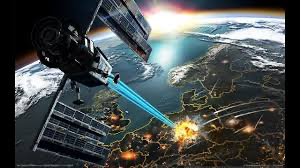
Space-based Weapons. Till recently, it was well established that space was militarised. Hitherto fore it will be weaponised[11]. Space-based weapons intending to attack targets in space or on the ground are on the horizon. These could be space-based ballistic missile defence interceptors and ground-attack weapons. These weapons will have to be necessarily placed in low earth orbits. These systems can be kinetic or non-kinetic in nature and can have effects that are either permanent or temporary[12]. Space based weapons could be ‘space to space’ or ‘space to earth’. The ‘space to space’ category will be discussed subsequently as counterspace capability. Space-to-earth weapons pose certain technical challenges at present and might not manifest in the short term. However their coming into the equation is a matter of time. The trends which will propel deployment of weapons in space include advances in miniaturisation of technology, convergence of diverse technologies into space design, new material capabilities and reduced costs of space operations due to commercialisation of space industry. One must also realise that space to earth capability to carry out ISR and monitoring is already in place including the communication linkages. A major factor which must be realised is that space based weapons need not always target hard ground based target or incoming missiles. As civil and military systems become increasingly dependent on space, they will be a proliferation of ground based systems and components to support the space based systems. In addition, every military system has a vast array of logistic material spread over large areas. These widespread and vulnerable targets (soft/semi soft) are ideal for interference by ‘space to earth’ weapon systems. Targeting these through space based weapons will be highly effective in either military or non-military contestations- in peace or war. In many cases the operation could be made into deniable & non attributable soft kills . The day is not far when the SDI concept of USA is a reality far beyond the original thought process. In this vein, it must also be understood satellites with laser/Directed Energy Weapon capabilities are easiest to deploy and proliferate in space.
Earth to Earth Through Space. There is another category of weapons which can be termed as the “earth to earth through space” systems . In its simplest form these are the ICBMs or MRBMs of the yore which necessarily go into space before making a re-entry into the atmosphere on their way to the intended targets. A later day version of these are missiles are those fitted with Multiple Independently Targeted Re-entry Vehicles (MIRVs) as warheads. A sophisticated version of these systems is the Fractional Orbit Bombardment System(FOBS)in which a missile is launched from earth and put into a low earth orbit and then turned suddenly on to its target to achieve surprise. A FOBS can suddenly be directed onto any unsuspecting target . However when such a system provides the launch platform for a hypersonic glide vehicle on re-entry in the atmosphere, it is a breakthrough moment[13]. That is what the Chinese hypersonic glide vehicle is all about. This is next gen space capability which fuses multiple technologies through space.
Counterspace Operations
Concept and Danger. Counterspace operations deny use of space capabilities to adversaries. They have turned from being passive to being offensive in the recent past. Nations are investing and developing counterspace capabilities at an unprecedented rate with established space faring nations at the fore front. Counterspace capabilities are being developed along five lines. These are direct ascent (also commonly known as ASAT), directed energy weapons, co-orbital satellites, EW, and cyber platforms. These systems pose a threat to an adversary’s space assets from the earth to geosynchronous spaces[14]. They are both destructive and non-destructive by nature. The major issue with counter space capabilities is that in a medium like space they tend to affect military and civil systems alike without differentiation. Hence use of counterspace systems has huge ramifications for the global economy which has increasingly become more dependent on space in day to day activities. The focus of counterspace operations is to achieve superiority in a particular domain at a time and area of choice. It will not be out of place to mention that the PLA aims enablement in unimpeded use of space based information systems and in denying adversaries their space-based information gathering and communication capabilities through counter space systems. This is a critical part of their concept of modern “informatized warfare” as they aim beyond and further at “intelligetised warfare”
Lines of Development. Direct-ascent anti-satellite (ASAT) weapons use a missile launched from ground to strike at satellites mainly in the LEO[15]. This capability exists with USA, Russia, China and India only. The effort is take ASAT capability into the high geosynchronous orbit. There have also been reports of the Chinese contemplating use of low yield nuclear weapons to take out an adversaries satellites in the LEO[16]. Co-orbital systems (also known as “space stalkers”[17]) are those which are placed in orbits close to the intended target satellites to effect a kinetic kill[18]. These have been tested out by advanced space faring nations. However , achieving a soft kill through co-orbital systems in the near future is also on the cards. Satellites can be destroyed or incapacitated using directed energy weapons like Lasers and High Powered Microwaves. These can be fired at the target satellite either from space based or ground based platforms. Soft kills aim to damage/destroy the electronics of the target satellite and cause irreparable damage to its circuits and processors. Incapacitating a satellite can be done through electronic interference of its up or downlink communication links through jammer systems which can be either ground or space based. Cyber operations against satellites is increasingly becoming the norm in which monitoring or interfering or falsifying or infecting data traffic from target satellites, their ground stations, communication networks or end-user equipment is being resorted to.
The Economy of Space Militarisation
The Potential of Privatisation. As per Mckinsey[19] “SpaceX, Blue Origin, and other private companies are launching their own rockets and deploying satellite constellations. These activities, once primarily the domain of government agencies, are now possible in the private sector because recent technological advances in manufacturing, propulsion, and launch have made it much easier and less expensive to venture into space and conduct missions. Lower costs have opened the door to new start-ups and encouraged established aerospace companies to explore new avenues that once seemed too expensive or difficult. The technological improvements have also intrigued investors, resulting in a surge of space funding over the past five years”. There is a boom in the space economy. India is also onto it. It is one of the few countries in which the space sector has been opened up. The Indian commercial space sector is on the threshold of a major privatisation drive.
Economy of Militarisation As militarisation of space progresses there will be a natural fusion of civil and military activities in space. Civilian organizations, universities, research establishments and military organizations will gravitate towards each other to augment all space related activities. In effect, the civil and military requirements will drive each other to enlarge the commercialisation of the space economy through profit generating launches, scientific endeavours, and space exploration. In 2021, the space economy was valued at $469 billion[20]. The rough estimate is that it will grow at about 10% annually. Presently the bulk of the value of the space economy is in the ground sector. As the costs of launching a satellite keeps falling and expansion of space launch facilities takes place, the overall economy is only set to grow further. As space launch and maintenance costs become cheaper, these systems will become more affordable for militaries even if they are small. Resultantly, countries with an established space program will see a huge uptake in profits and income through end to end provision of space services. In sum, the economy of militarisation will increase and benefit those countries with mature space programs immensely.
Space and Military Technology
Space and military technology have an umbilical connect. Space is the toughest environment for survival. It is harsh and hostile for both manned and unmanned satellite operations. Any system or technology which survives in space will naturally survive in the battle field. I had earlier written[21] that “any space based systemcontains technologies which have a natural application on the battle field. Mastering space system technologies like robotics, nuclear, new Materials, ultralight devices and high-strength materials , super conductors, Hydrogen energy systems , AI, communications, energy harnessing, and cyber-space (to name a few) will have immense payoffs in development of advanced cutting edge weapon systems”.
As modern and advances systems are inducted into the battlefield, they will need an increasing amount of energy. The current method of utilising fossil fuel for our battle requirements , especially in our high altitudes is logistically untenable in the long run from any point of view as also form an environmental perspective. Hydrogen technology which is sheet anchor of space system energy has the potential to meet most of the energy requirements in operational environments. Renewables and green energy systems will be even more important high altitudes, in inhospitable and remote areas. Battlefield stamina and mobility will improve if fuel cell technologies which are essential for space systems are used in the military.
Security of Space Systems
Every space based system be it for ISR, meteorology, navigation, communication or counterspace is dependent on a vast array of ground based systems which are interconnected. As militarisation and weaponization of space expands, the vulnerability and hence the security of these systems will also increase. Their physical and non-physical security assumes greater importance on ground. Similarly as adversaries start deploying their space assets , their ground infrastructure and networks will also expand to become vulnerable. These vulnerabilities will sooner than later be discerned and exploited. This is a military aspect which has received much less attention than it deserves. However most militaries will get around to it. Protection and denial of own ground infrastructure which support space activities and exploiting weaknesses in an adversary’s infrastructure will assume importance.
The Energy Scramble
As the world’s reserves of fossil fuels deplete, there is a scramble in space for energy. One option is to harness energy from space based solar power. The other option is to obtain Helium-3 and Deuterium from space and fuse them to produce energy. The reason to go to moon is to mine it for water and Helium-3[22]. Water, often called the “oil of space”, if obtained in sufficient quantity from Moon provides the energy to travel to Mars and for mining Helium-3 from the Moon surface. The reason to go to Mars is to mine it for Deuterium. Presence of Deuterium in Mars is about five times that on Earth. The combination of Helium-3 from Moon and Deuterium from Mars enables feeding the fusion process. Though the fusion process is complicated, the lab scale model has been successfully developed in USA in Livermore[23]. The next step is to establish a fusion reactor, which could take another decade to establish. There is another indirect option. That is to mine asteroids/moon/mars surfaces for rare earths. Rare earths if obtained there in sufficient quantities will help in making superconductors which will substantially reduce energy consumption. It is in this context that the Moon and Mars program of USA, ESA, China, Russia and India make sense. Countries which harness energy from space and achieve energy dominance will be the future global powers in a depleting energy scenario [24].
The Space Force
As activities in space have increased manifold, there is huge competition unfolding from the earth surface all the way to the Mars. The security requirements of space based assets has increased. Hence nations are also putting together resources to create Space Forces. The USA established the U.S. Space Force on Dec. 20, 2019 with a mission to “Secure its Nation’s interests in, from, and to space”.[25] As per the US thought process “space is a national security imperative” and “there is a need for a military service focused solely on pursuing superiority in the space domain”. China on the other hand established the PLA Strategic Support Force (PLASSF) in late 2015. This force looks after all space related activities of the PRC along with its netcentric and information war capabilities. It integrates PLA’s space, SIGINT, cyber, electro-magnetic and psychological operations capabilities under one umbrella. One of the main tasks of the PLASSF is to provide security for China’s growing Chinese interests and capabilities in space[26]. Given the way these two countries are progressing, it is high time that India starts thinking of a Space Force of its own to safeguard its fourth domain of war.
Geopolitics of Space Militarisation
In the days of the yore geopolitics around space was a bipolar affair between USA and USSR. However in the present scenario there is multipolar dynamic in space. Major countries in the space race are USA, Russia, China and India[27]. Other countries which have been making forays into space are Japan, Canada, UK, France, EU and Israel[28]. In the realm of great power competition, space is an important domain where there is a fierce jostling for position. The position revolves around technological prowess, soft power projection and national capabilities. Major space powers are competing for influence through achievements in space and posing threats through its militarisation. At the same time there is a scramble for energy and resources into asteroids and planets beyond the GEO[29].
Conclusion
There should be little doubt that Space is not only being militarised but also weaponised. Further as technologies improve, the ubiquity and importance of Space in battle is increasing. More importantly the divide and the gap between the civil and military aspects of space is almost non-existent. In this context military and space agencies must get their act together by acting in concert with each other. Militaries of tomorrow must understand space better to be able to utilise it better. If not, they will be left out of the race. The Indian government and military has to take a call in this regard.
[1]Space: The Fourth Military Dimension. The Strategic Defense Initiative and the Implications for Land Warfare in the Twenty-First Century Defense Technological Information Center, Accessed on 16 Feb 2024, https://apps.dtic.mil/sti/citations/ADA181427#:~:text=This%20study%20considers%20space%20as,the%20Army%20began%20around%201983.
[2] Samantha Marquart, Space Power: A Unique Military Asset, accessed 18 feb 2024, https://www.iar-gwu.org/printarchive/dsg88kx84rnur2d523e47hj7pe9ger#:~:text=Space%20power%20became%20a%20key,substantial%20advantage%20in%20the%20war.
[3] Lt Gen (Dr) R S Panwar, Cyberspace: The Fifth Dimension Of Warfare – Part II, accessed 18 Feb 2024, https://futurewars.rspanwar.net/cyberspace-the-fifth-dimension-of-warfare-part-ii/
[4] https://apps.dtic.mil/sti/citations/ADA422254
[5] Neeraj Mahajan, Cognitive Domain: The Sixth Domain Of Warfare, Def Strat, Vol 16 Issue 6 Jan – Feb 2023, Page 42, https://www.defstrat.com/magazine_articles/cognitive-domain-the-sixth-domain-of-warfare/
[6] Satellite Navigation – GPS – How It Works, Federal Aviation Administration, USA, Accessed on 19 Feb 20204,https://www.faa.gov/about/office_org/headquarters_offices/ato/service_units/techops/navservices/gnss/gps/howitworks
[7] TechTarget Contributor, low Earth Orbit (LEO) Satellite, Accessed on 16 Feb 2024, https://www.techtarget.com/whatis/definition/low-earth-orbit-LEO-satellite#:~:text=LEO%20satellites%20are%20commonly%20used,delay%20results%20in%20less%20latency.
[8] Geostationary Satellites: Definition, Application, Limitations, Unacademy, Accessed on 17 Feb 2024, https://unacademy.com/content/neet-ug/study-material/physics/geostationary-satellites-definition-application-limitations/
[9] Geostationary Satellite, Science Direct, Synoptic Analysis and Forecasting, 2018, Accessed on 17 Feb 2024,
https://www.sciencedirect.com/topics/earth-and-planetary-sciences/geostationary-satellite
[10] Strategic Defense Initiative (SDI), 1983, U.S. Department of Space, Archive, Accessed on 18 Feb 2024, https://2001-2009.state.gov/r/pa/ho/time/rd/104253.htm
[11] An Introduction to Space Weapons, Ensuring Space Security, Accessed on 18 Feb 2024, https://www.ucsusa.org/sites/default/files/2019-09/intro-to-space-weapons.pdf
[12] Fact Sheet: Space Weapons, November 15, 2023, Centre For arms Control and Non Proliferation, Accessed on 17 Feb 2024 https://armscontrolcenter.org/fact-sheet-space-weapons/
[13] Jeffrey Lewis, China’s Orbital System is Big Bad News – But Not A Breakthrough, Prolifetation News, Carnegie Endowment For International Peace, accessed on 17 Feb 2024, https://carnegieendowment.org/2021/10/19/china-s-orbital-bombardment-system-is-big-bad-news-but-not-breakthrough-pub-85606
[14] Global Counterspace Capabilities, An Open Source Assessment, Accessed on 17 Feb 2024, https://swfound.org/media/207350/swf_global_counterspace_capabilities_2022_rev2.pdf
[15] Stephen Fallon, The Ongoing Militarisation of Space, Parliament of Austarlia, Accessed on 15 Feb 2024,
[16] Tanmay Kadam, China Uses Nuclear Anti-Satellite Weapon To Destroy Space Target In Simulation Drills; Is Elon Musk’s Starlink A Target? Accessed on 16 Feb 2024, https://www.eurasiantimes.com/china-uses-nuclear-anti-satellite-weapon-to-destroy-space-target/#:~:text=In%20simulation%20drills%2C%20Chinese%20military,China%20Morning%20Post%20(SCMP).
[17] Stefan Cako, The Challenges of Russian Militarisation of Outer Space, Accessed on 15 Feb 2024, http://www.diva-portal.org/smash/get/diva2:1517053/FULLTEXT01.pdf
[18] Counterspace Weapons, Aerospace, Accessed on 15 Feb 2024, https://aerospace.csis.org/aerospace101/counterspace-weapons-101/#:~:text=Co%2DOrbital%20ASAT&text=The%20attacking%20satellite%20is%20first,the%20path%20of%20another%20satellite.
[19] Ryan , Brukardt, How Will The Space Economy Change The World? Mckinsey Quarterly, November 2022, Accessed on 15 Feb 2024, https://www.mckinsey.com/industries/aerospace-and-defense/our-insights/how-will-the-space-economy-change-the-world
[20] The space economy is booming. What benefits can it bring to Earth? 19 October 2022, World Economic Forum, Accessed on 17 Feb 2024, https://www.weforum.org/agenda/2022/10/space-economy-industry-benefits/#:~:text=The%20space%20economy%20is%20worth,according%20to%20a%20new%20report
[21] Lt Gen P R Shankar (R), India’s Energy Security Through Space, PINNACLE, The ARTRAC Journal, Vol 19, 2020, Pages 165-179, https://gunnersshot.com/2021/06/16/indias-energy-security-through-space-by-lt-gen-p-r-shankar-r/
[22] Helium-3: Lunar Gold Fever, Accessed on 14 Feb 2024, https://www.bbvaopenmind.com/en/science/physics/helium-3-lunar-gold-fever/
[23] A shot for the ages: Fusion ignition breakthrough hailed as ‘one of the most impressive scientific feats of the 21st century’, Lawrence Livermore National Laboratory, Accessed on 16 Feb 2024, https://www.llnl.gov/article/49301/shot-ages-fusion-ignition-breakthrough-hailed-one-most-impressive-scientific-feats-21st
[24] Lt Gen P R Shankar (R), India’s Energy Security Through Space
[25] About The Space Force, United States Space Force, Accessed on 20 Feb 2024, https://www.spaceforce.mil/About-Us/About-Space-Force/
[26] Li Nan & Ryan Clarke, The New Strategic Support Force Of The Chinese Military and Implications For Regional Security, EAI, Background Brief No 1606, 25 Aug 2021, https://research.nus.edu.sg/eai/wp-content/uploads/sites/2/2022/07/EAIBB-No.-1606-PLASSF-and-Regional-Security-2.pdf
 Gunners Shot
Leave a comment